Home
How to set up an index card cleaning system that runs itself
Tabs, categories, what to write on each card, and the one rule that stops the box from piling up.
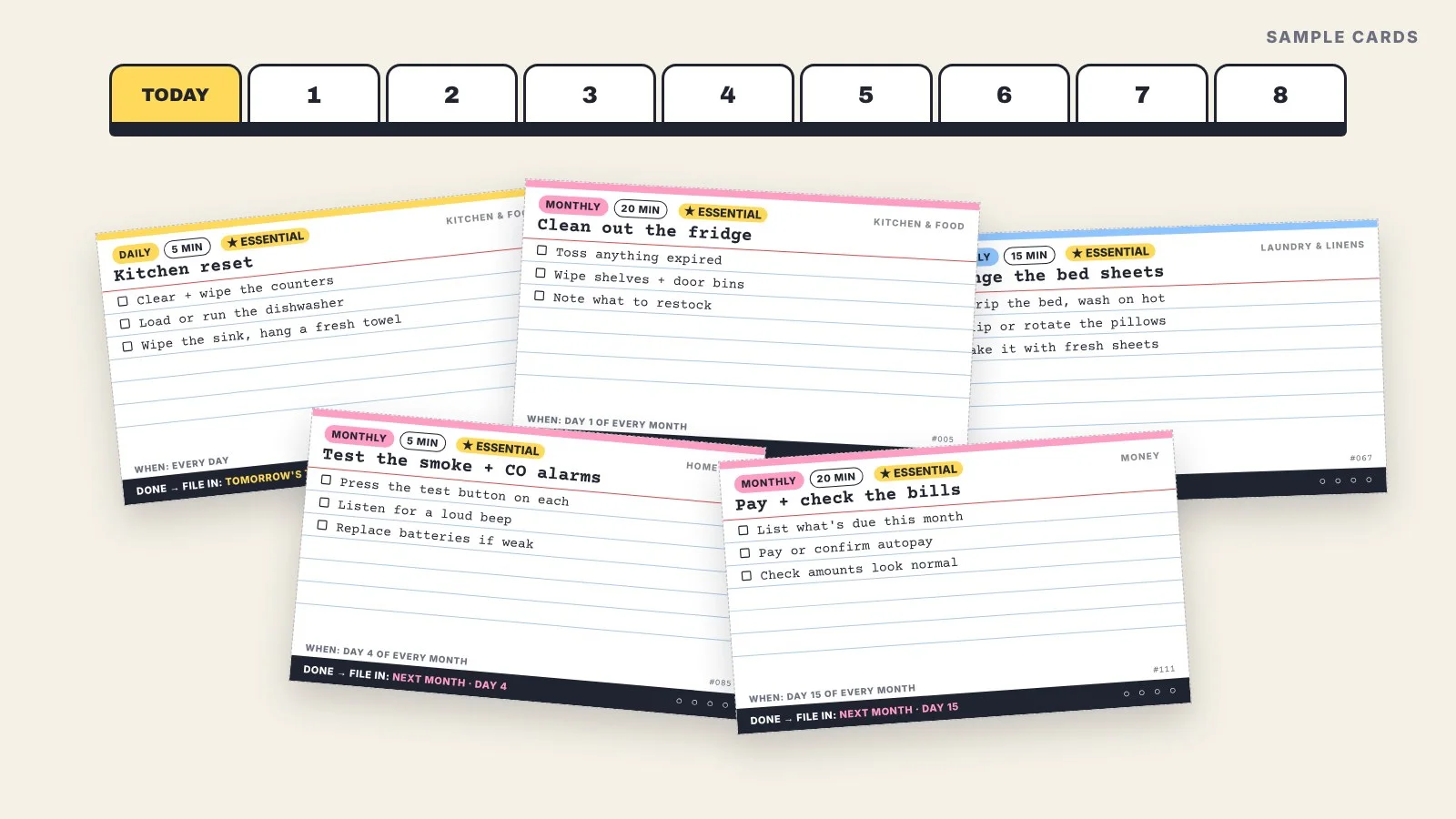
An index card cleaning system is a small box of cards: one task per card, filed behind the day it is due. Each morning you pull today's cards, do what you can, and file each card forward to its next date. Nothing to remember, no app to open.
Most people get stuck on the same two questions: what do I write on the cards, and how do I stop the box from turning into a guilt pile? This guide answers both.
What you need A recipe box or card box that fits 3x5 or 4x6 cards About 250 index cards (lined is easier to read) Divider tabs: one labelled TODAY, one for each day 1 to 31, and one for each month JAN to DEC Two extra tabs: MY CARDS for tasks you add later, and PAUSED for cards that don't fit your life right now
Put the tabs in that order: TODAY at the front, then the day tabs, then the month tabs, then MY CARDS and PAUSED at the back.
Pick your categories first
Starting from a blank card is where most systems stall. Decide the areas of your home before you write a single card. Ten areas cover most households:
Kitchen and food Cleaning Laundry and linens Home care (filters, gutters, smoke alarms) Money (bills, subscriptions, budget) Paperwork Health (appointments, medicine refills, medical info) Family and pets Car Seasons (holiday prep, garden, winter kit)
You don't need all ten on day one. Skip any area that doesn't apply, like Car if you don't drive.
Decide how often each task happens
Give every task one rhythm. Keep it simple:
Daily: a 5 to 10 minute reset, like the kitchen or a quick tidy Weekly or every 2 weeks: floors, bathrooms, sheets Monthly: clean out the fridge, pay and check the bills, test the smoke alarms Seasonal (4 times a year): shower curtain, bathroom cabinet, range hood filter Twice a year: kids' wardrobe size check, flip or air the mattress, smoke alarm batteries Yearly: chimney check, next year's budget, review insurance policies
Most cards end up seasonal or yearly. That is the point: the box remembers the jobs you only do a few times a year, which are the ones that usually get forgotten.
What to write on each card
A good card can be done without thinking. Five lines are enough:
The task, short and specific: "Clean out the fridge", not "Kitchen". Three steps. "Toss anything expired. Wipe shelves and door bins. Note what to restock." How long it takes, so you can pick a short card on a busy day. When it happens: "Every Monday", "Day 8 of Jan, Apr, Jul, Oct", or "Sep 5 every year". Where it goes next: "Done → file in next Monday" or "Done → file in APR, day 8".
That last line is what makes the box run itself. When you finish a card, it tells you exactly where to file it.
Your daily routine In the morning, move the cards from today's number into TODAY. Work through them. Tick a small circle on the card when it's done. File each finished card where its last line says. On the 1st of each month, open that month's tab and spread its cards into the day tabs.
A day tab that is behind today means next month. Filing a card behind "3" on the 20th means the 3rd of next month.
The 3-day rule (this is what stops the pile-up)
The box fails when you miss a few days and come back to twenty cards. So set one rule before you start:
A card more than 3 days late is skipped, not done late. File it straight to its next date and move on. The fridge will come round again next month. You just open today's tab and carry on.
Start small
Writing 200 cards on a Sunday afternoon is the fastest way to quit. Ramp up instead:
Weeks 1 to 2: only your most important cards, about 2 a day. Learn the habit: open, do, file. Weeks 3 to 4: add Kitchen and Laundry. Month 2: add Cleaning and Home Care. Month 3 and later: add the rest, or keep some areas in PAUSED. Want the cards already written?
If you'd rather skip the writing and scheduling, our Pre-Filed kit has 200 home task cards already written across these 10 areas and scheduled for 2027, with every card's "file in next" line printed on it. It includes 58 starred Essentials to start with, 3x5 and 4x6 versions, 50 dividers, and a Year Map spreadsheet that shows which cards come up when. Starting with the Essentials takes about 20 minutes on a typical weekday plus the daily resets.
There is also a free set of the 10 categories and 30 starter cards if you want to try the method first.
This article is general information to help you organize your own home. It is not legal, tax or financial advice.